The World Reimagined

Region

Bristol

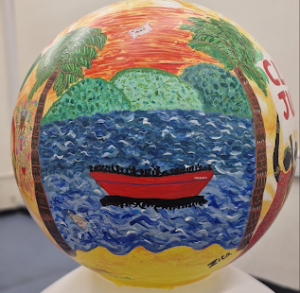
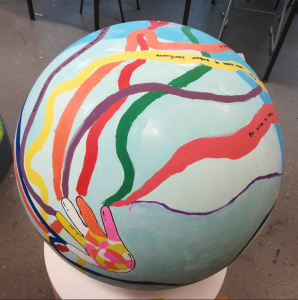
This exhibition is the culmination of intergenerational and international conversations explored through The World Reimagined’s Triangle of Unity Learning Programme. Each Globe captures the pupils’ reflections on heritage, identity, and our shared environment, offering powerful insights from the next generation. By amplifying young voices and their creative responses, The World Reimagined aims to strengthen community connection and promote deeper understanding across the UK.

About the Artist

Roz, founder of Complex Simplicity, is a UK-based visionary designer and visual artist working at the crossroads of design, art and social impact.

With over 25 years experience working across costume/fashion/textiles design and mixed-media visual art, her practice combines avant-garde design, in-house production and bespoke commissions for private and corporate clients, alongside powerful, socially engaged visual art.

Alongside her design studio, Roz collaborates nationally with educational institutions, cultural organisations and community groups, delivering bespoke projects, creative workshops, mentoring, consultancy and training. Her freelance roles include Creative Partner, Facilitator, Lecturer, Mentor and Artist-Educator – connecting creativity with learning, dialogue and real-world change.

Balancing bespoke design commissions, freelance consultancy roles and visual art, this multidisciplinary approach fuels a dynamic body of Avant-Garde work rooted in sustainability, ethical practice and social consciousness. These values remain as a fundamental, underlying element of all community projects undertaken and commissioned artworks produced, using creativity as a tool for dialogue, reflection and meaningful transformation.


About the Globe

A bold, creative interpretation by a visionary artist/designer that examines global history and contemporary social issues through an Avant Garde lens.

An eclectic fusion of vibrant colours, layered mixed media, experimental techniques and thought-provoking imagery expose the interconnected impacts of fast fashion, climate justice, racial (in)justice & transatlantic and modern day slavery – issues often overlooked yet deeply embedded in everyday life.

Postage stamps and handwritten letters drift across the surface as fragments of memory, referencing migration, family history and key periods within history (including Windrush), along with stories carried across oceans and generations.

Seemingly hastily drawn, unrefined/somewhat incomplete fashion illustrations are intentionally featured to reflect the culture of fast fashion, symbolising disposability, exploitation, stolen legacies and short-term consumerism.

Metal bars and chains interrupt the form, representing confinement and oppression (past and present), while the desire for escapism is represented in hands breaking free, prison bars being prised open, turbulent waves now flowing freely and compelling, deep sunset tones which convey resilience, hope and transformation. 

This visionary Visual Artist aspires for the globe to invite viewers to reconsider their first impressions, acknowledge shared histories and reflect on our collective responsibility to shape a more equitable and sustainable future.

COMPLEX SIMPLICITY

A WORLD UNCHAINED: ETERNAL JUSTICE
Theme:

COMPLEX SIMPLICITY

About the Artist

JILO is a collaborative artist duo formed by Joshua Obichere and Lilo Amaral, MA Fine Art graduates of Central Saint Martins. Drawing from their heritage in Brazil, Ghana, Nigeria and the UK, JILO builds immersive community driven works rooted in cultural storytelling and social justice. Their multidisciplinary practice, spanning painting, sound installation and socially engaged projects, utilises tactile materials like grout and acrylic to create vibrant spaces of reflection and care. Driven by curiosity and a commitment to creative wellbeing, JILO explores the transformative power of art to bridge global histories and foster collective healing.

About the Globe

Current$ea is a striking sculptural globe that maps the enduring legacies of the transatlantic slave trade through the visual language of global currency. The work features seven meticulously designed banknotes, each representing a continent and subverting traditional symbolism: red for resistance and bloodshed, blue for forced oceanic crossings, green for the land, and gold for extraction. To create its unique, tactile presence, the sculpture is rendered in textured grout and finished with vibrant acrylic paint, giving the “fictional currencies” a rugged, physical weight. From the Pan-African reclamation of the Black Star to the fluid movement suggested by its title, Current$ea serves as a powerful reminder of how historical economic flows continue to shape, connect, and divide our modern world

Jilo

CURRENT$EA
Theme:

Jilo

About the Artist

Amy Hutchings is a visual artist based in Bristol. A printmaker, mural artist and artist facilitator, her practice incorporates silkscreen print, etching and spray paint.

She endeavours to capture a sense of place and evoke memory within her work through the use of descriptive line, abstract colour and texture.

She is currently Artist in Residence for a year with Artshub in East Harptree, which provides access to an incredible studio, and involves community engagement with residents in the Chew Valley and Mendips.

Amy is responsible for running monthly workshops with refugees and asylum seekers at Spike Print Studio, works as Art Facilitator for the RWA with SEN+D schools and families, as well as delivering sessions for Mothers with postnatal depression. She runs creative workshops for a group of care homes in Bristol, delivering art projects for dementia sufferers and elderly participants. She believes art is for everyone and is passionate about enabling the visual voice of others.

Amy is passionate about hand-made techniques and embraces the quirks of process that come from traditional methods of working. She loves to draw – her ideal day would involve translating drawings onto another material, injecting colour and texture and being immersed in the making. 

She is a huge fan of descriptive line, abstract colour and pattern. She loves biscuits.

About the Globe

“The earth is the earth is the earth”, is the final line of Caribbean poet, Grace Nicols poem, “Hurricane Hits England”. She wrote it following the Great Storm of 1987. It reminded her of Guyana and made the UK feel more like home.

Winds circumnavigate the globe, as water flows around the earth, echoing the movement of people.

We are all connected.

However, the positive aspect of a visiting hurricane, felt by Nicols, is rarely the way violent weather is received.

Hurricane Melissa hit Jamaica on 28th October 2025. Fuelled by the climate crisis, Melissa caused death and destruction with her accelerated windspeeds, leaving a path of devastation across the Caribbean.

Climate justice sits hand in hand with racial justice. Funds, generated from the enslavement and trafficking of Africans, lined the pockets of the global north – money which helped lubricate the industrial revolution and advancements which have contributed to human-made climate change.

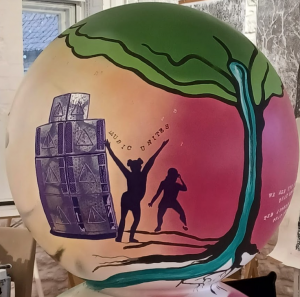
Soundsystem culture arrived in the UK with the Windrush generation. They brought music that inspired new musical culture. The soundsystem pictured represents the pioneers of trip hop, drum n bass, and the Bristol Sound. It celebrates the joy of St Pauls carnival, the forging of new friendships, and the strength of community.

Music moves around the globe with people – an ever-changing tide, connecting us all.

Tree roots symbolise our connection to each other, our connection to our past, our connection to nature. The branches reach towards a hope-filled future.

“The earth is the earth is the earth.”

Quotations and acknowledgements on the globe:

    Original photo inspiration of the Super Charge Soundsystem, courtesy of Peter Dub.

    Climate justice quotation, from Jamaican economist, Mariama Williams, speaking at Cop30. Guardian, article, ”Hurricane Melissa,  ‘a real time case study’ of colonialism’s legacies”.  15th November 2025.

    Quotation, “The earth is the earth is the earth”, from Grace Nicols, A Hurricane Hits England.

    Quotation from the Indigenous Peoples of the Amazon, during a collaborative event with Massive Attack and Cavalera, during Cop30, article published on Pitchfork, 15 September 2025.

    Statistics from TVJ, 3rd December 2025 on Midday News, and www.worldvision.org – Hurricane Melissa: facts.

Amy Hutchings

THE EARTH IS THE EARTH IS THE EARTH
Theme:

Amy Hutchings

About the Artist

Kaleb D’Aguilar is a multidisciplinary artist and filmmaker who resides between London and his homeland Jamaica. Keenly interested in capturing ‘the everyday’ Kaleb’s work explores recurring themes of Blackness, Caribbeanness, gender, sexuality, migration, familiar bonds, and the intersectional identities found between these margins. His poetry and prose work has been published in numerous collections including PREE and the National Library of Jamaica’s ‘New Voices’ while his narrative film and video work have been showcased on American Airlines in-flight entertainment, the V&A, Migration Museum, National Gallery of Jamaica as well as regional and international film festivals.  Kaleb is currently serving as an adjunct lecturer in the film department at the University of the West Indies, Jamaica.

Tara Jerome-Bernabe [TJB] is a multidisciplinary artist whose practice centres around elevating voices in need of exposure; a cry from Earth’s deities, indigenous existences and mistreated souls. From palm leaves to ionised soils, they blend organic materials in mixed media pieces of varying scales. Through compositions, poetry, handcrafted instruments and costumes Bernabé’s performance art pieces create modern-day folk stories that lead the audience through a sensory experience, invoking curiosity, introspection and blurring the line between magic and realism. Their performances feature handcrafted instruments inspired by natural forms and sounds. The costumes are fashioned out of leaves, seeds, reeds and other workable organic matter. In their paintings, Bernabé experiments with homemade pigments such as coffee and mud, believing that adding living materials to the pieces breathes life itself into the work. Their approach to sourcing and producing their own materials from natural settings urges others to detach from destructive colonial, globalised and anthropocentric infrastructures, favouring localised, ancestral knowledge and the Earth’s commons.

About the Globe

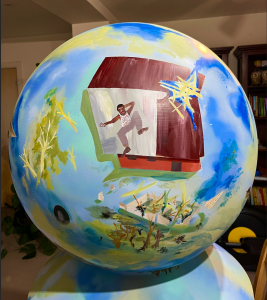
In the wake of Hurricane Melissa which devastated sections of Jamaica late October 2025, when the water came in explores the aftermath of natural disasters and its effects on the people, land and infrastructure. It addresses the violent displacement of everyday life, but is more concerned with capturing the cruel mundanity in waiting for aid. Powerful tropical cyclones like Hurricane Melissa are a result of the global climate crisis, but the effects are deeply felt in small island territories. In thinking about this sense of isolation and hopelessness, paper airplanes are reimagined as a means of communication, but highlights the fleeting dreams and unfortunate realities of a home underwater.

Kaleb D'Aguilar with TJB

WHEN THE WATER CAME IN
Theme:

Kaleb D'Aguilar with TJB

About the Artist

The Global South only produces 8% of excess carbon emissions. The rest? The other 92%? The Global North are accountable.

Wealthy, industrialised countries are almost solely responsible for warming the planet and changing climate. They also have the most resources to mitigate against the effects of climate change. But it is the Global South that is being hit hardest by climate disasters, despite having contributed the least to the root causes. Unequal emissions and unequal access to means of survival.

This is climate apartheid – a systemic segregation rooted in historical injustices from slavery to colonialism and racial capitalism. A planet with unequal access to food, water, energy, land, shelter and safety. A world where the rich still believe they can overconsume and then buy their way out of the problem without concern for the part of the story they cut out. Without concern for the people they cut out.

With this artwork I wanted to tell the full story and to make visually apparent the far-reaching and very serious consequences of our actions. It felt important to show that we are all connected, that all of our actions are connected. And that our choices are causing devastating effects on the land and lives of others. Let’s choose better.


About the Globe

Sarah-Jane Mason is a Creative Practitioner, Facilitator & Educator who specialises in using mixed media approaches to personal and participatory arts projects. She believes that creativity is the key that unlocks learning and that cultivational actions and experimentation are important elements of the creative process.


Sarah-Jane comes from a traditional Fine Art background. She studied for a BA (Hons) Fine Art at Liverpool John Moore’s University (UK) and DipCipris (a postgraduate degree) in Fine Art at the Cyprus College of Art (Cyprus). Continuing her studies, she focused on creative education, completing a PGCE (Art & Design) at the University of Leeds (UK) and a Post-16 Teaching Certificate at Cyprus College of Art (Cyprus). A life-long learner, Sarah-Jane also has a Yoga Teacher Training certificate, is a mental health first aider and has recently been certified Carbon Literate.


Sarah-Jane’s personal practice uses mixed media approaches to encourage dialogue around uncomfortable but important topics, question societal norms and compare and contrast people’s experiences of a particular space or place. Her work often includes elements of mass media or found natural objects, questioning the impact these sources and resources have on our worldviews and everyday lives. Humour and colour are also of great importance to her work, bringing warmth and openness to encourage dialogue and collaborative working practices.


Recently, development has begun on The Lacuna Studios, an artist studio and residence on an ecologically regenerative olive grove in southern Spain. Notions of care, creation, destruction, cultivation, experimentation and production are some of the foundational principles. This project has grown out of Lacuna Festivals, an international, contemporary art festival. Her role as co-director is an important aspect of her arts practice and provides an opportunity to create and hold a space where artists and audience members can interact, question, share and otherwise meaningfully engage with each other. She is supported in her work for Lacuna Festivals and The Lacuna Studios by co-director and land artist Simon Turner.


As part of her work for lifelong learning focused on creative education, Sarah-Jane plans and delivers participatory arts projects, often aimed at those for who there may be significant barriers to engagement. In addition, Sarah-Jane runs a publishing company, Next Generation Publications, that publishes visual books created by and for their audience. She was worked with children and young people, teachers and artists to create and publish peer developed publications. Past books are held in the British library collection as well as in local libraries, schools and community centres.


You can find out more about Sarah-Jane’s practice online at the following links:

www.sarahjanemason.com

www.instagram.com/sarahjanemasonartist

www.thelacunastudios.com

www.lacunafestivals.com

www.nextgenerationpublications.com


Sarah-Jane Mason

THE PART (OF US) WE CUT OUT
Theme:

Sarah-Jane Mason

About the Artist

Zita Holbourne FRSA is a multidisciplinary artist, an author , a community activist, equality and human rights campaigner and trade union leader. 

In her creative practice, Zita works as a visual artist, poet, writer, vocalist and educator.  She has exhibited art and performed poetry around the globe. Her original globe, created for The World Reimagined, entitled Still We Strive, is now permanently located at the Black Cultural Archives in London. Zita is the author of Striving for Equality, Freedom and Justice, published by Hansib Publications and has contributed to over 50 books. Her new book about her life of activism will be published by Aurora Metro in 2026.

Zita is the co-founder and chair of BARAC UK, Co-chair of Artists’ Union England, a member of the Mayor of London’s Liberty Advisory Group and Chair of  Public Services International Education Support and Culture Sector Workers Network.

Awards and recognitions include:

Fellow of the Royal Society of Arts, Honorary Fellow of University of Wales Trinity Saint David, 100 Black Women Who Have Made a Mark, National Diversity Awards Positive Role Model for Race, Legacy Lifetime Achievement Award for Equality Champion, Ethnicity List 100, Global Diversity List 2023, Olive Morris Award, two Caribbean Global Awards for Outstanding Global Arts and Culture and for Best Global Community Influencer.

Zita works for equality, freedom, justice and human rights through arts and activism.


About the Globe

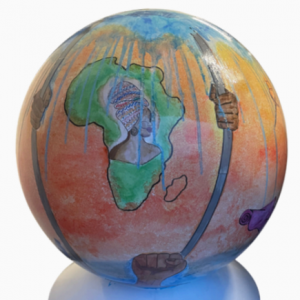
Zita’s globe is loosely divided into different  segments which document:

Climate Justice and the Global South. 

Linked to this is Displacement and Migration and impacts of perilous journeys and separation from loved ones. Embracing heritage and roots through intergenerational story telling and representing rest because self and collective care are  needed.

Resistence, resilience and protest.

References to the history,  contributions of and resilience in challenging racism of Black people and communities in Bristol. References to Pan Africanism and Adinkra as a source of strength, unity and learning  including the Sankofa bird.

The three flags represent Jamaica, in recognition of the devastating  impacts of Hurricane Melissa and the positive impacts of Jamaican culture on the world, a twist on the St George’s flag  which has bern used in recent times by some to represent racism and fascism to represent the multi- culturalism of  the people who make up England and of St George himself and the red, yellow and green flag for Pan African symbolism.

The orange swirling background represents impacts of climate change on our burning planet and global warming against a backdrop of global political turmoil. 

The green swirls on the top represent growth, nature and healing.

The letter and triangle repeated  on the base represent the Triangle of Unity in rotation around the swirling sun, which wind around the top of the base, upright, then flipped upside down created a bridge from the letter U and a mountain plateau from the triangle, symbolising connection, safety and rest.  The solid ( filled in) U and triangle symbolise the building of a solid foundation.


Zita Holbourne FRSA

RACE EQUALITY AND JUSTICE IN OUR LIFETIME
Theme:

Zita Holbourne FRSA

About the Globe

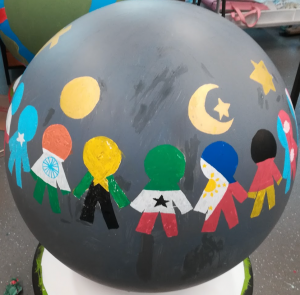
Our globe celebrates the diversity of the cultures represented within our classroom and school community. It features people holding hands with flags representing different cultural identities, symbols of different religions and ‘untied in diversity’ written in different languages. Together, these elements show that honouring and sharing our unique cultural identities, we create a connected, inclusive and vibrant community.

MONTPELIER

UNITY IN DIVERSITY
Theme:

MONTPELIER

About the Globe

Our globe illustrates the complex relationship between AI and our planet. It highlights the negative environmental impacts of AI, such as increased greenhouse gas emissions caused by the high energy needed to power advanced technologies. At the same time, we wanted to show how AI can be used responsibly to support climate action- tracking forests, oceans, and wildlife through satellite data, and helping to predict extreme weather through early-warning predictions. Our message is to inspire people to consider responsible and sustainable AI use to help address environment challenges.


MONTPELIER

THE CLIMATE CODE
Theme:

MONTPELIER

About the Globe

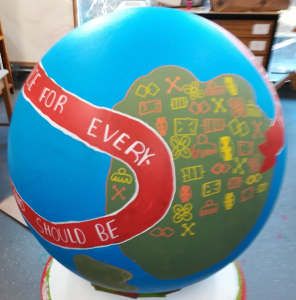
Our globe explores the conversations shared between people from different generations. We reflected on how love, stories, memories and traditions connect us across ages. Students interviewed family members and asked the questions they believe generations should be discussing in 2025. Quotes from the interviews were placed on the globes to show that every generation has wisdom to share- and that we learn from one other through conversations.

MONTPELIER

CONNECTING GENERATIONS
Theme:

MONTPELIER

About the Globe

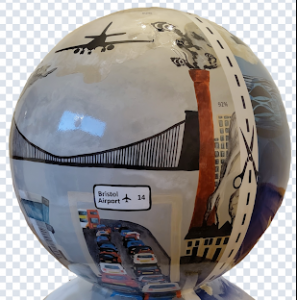
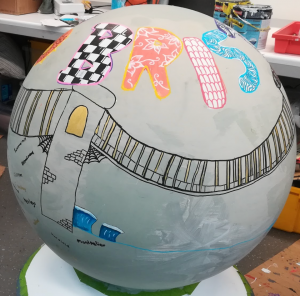
This globe celebrates the energy, creativity, and culture that makes Bristol unique. From its iconic suspension bridge to the balloon fiesta and the vibrant graffiti- students have shared the things they love most about the city. Together, these elements capture the spirit, rhythm, and vibe of Bristol- We love our city!

MONTPELIER

BRISTOL IS GERT LUSH!
Theme:

MONTPELIER

About the Globe

Our globe sends a powerful message to the world, aiming to empower communities. In the lead-up to our design, we discussed how the Transatlantic Slave Trade remains prevalent in our society, whether through climate impacts or socio-economic inequalities. We reflected on how the legacy of the slave trade made us feel and how we wanted to communicate this message.

Despite our sadness about the inequality it has caused, we wanted to highlight themes that reflect hope. The themes we chose to focus on were celebration of previously enslaved cultures, remembrance of the lives that have been lost, and the strength of courageous people who continue to fight against its lasting impact. We decided that the best way to represent these themes was through the careful selection of Adinkra symbols to support our call to action and images of resistance.

MONTPELIER

FIGHT FOR YOUR CULTURE
Theme:

MONTPELIER

The World Reimagined is a company limited by guarantee (#12501914) and a registered charity (#1195223). 

Privacy Modern Slavery Statement

Our Host Cities

Birmingham
Bristol
Leeds
Leicester
Liverpool City Region
London
Swansea

Pages

Sign up to our newsletter